
On-Chain Art Since 2012

Hey everyone!
Remember when MP3s first hit? I was 15, on AOL, bumping my first MP3, Chumbawamba's Tubthumping, between random Lagwagon tracks in some tricked-out media player visualizer. Half the time, the file you downloaded was something else entirely, stealthily renamed, but sometimes that meant accidentally discovering a new favorite local band.
Before MP3s became easy to find, your best bet was often a RealAudio stream that sounded like a telephone held underwater, and you’d wait 30 minutes for the privilege. Then Napster arrived and dropped “P2P” into the zeitgeist, paving the way for LimeWire, Kazaa, and BitTorrent, where invite-only trackers like OiNK drew members like Trent Reznor and made FLAC the new digital vinyl. Fans uploaded rare tracks, live recordings, bootlegs, and deep cuts. For a while, it felt like distribution by the community, for the community.
Then came the crackdowns and the lawsuits. Streaming rolled in and “solved” piracy by making music feel unlimited, driving the perceived value of a recording toward zero in the process. As a musician, I watched it happen in real time: CDs for $20, then tracks for a buck in the MP3 era, then fractions of a cent once the world moved to Spotify, and eventually paying Spotify to distribute my own music.
Then, around 2010, we got a completely new peer-to-peer primitive: the blockchain.
A Weekend Experiment
Proof of work appeared as something genuinely new. Suddenly I was trying to find books on game theory and asking professors about “crypto-economics.” None of whom had heard of it yet. I remember watching YouTube videos on “how blockchains work,” following short tutorials that could get something crude running locally. But without a community to launch a chain, or the low-level networking skills to do it properly, all I could really do was admire the technology from the edges. The idea felt like some relic from the future handed back through time.
Then came Namecoin.
Namecoin pushed a simple but important idea: what if you could use a blockchain to store arbitrary bytes, not just move coins around? Technically, you could already do strange things with Bitcoin transactions, but they mostly looked like weird values being sent around. Namecoin made the idea structured. It opened up a new kind of freedom for on-chain experimentation.
I set up a site to explore different charting ideas. Renko charts, volume indicators, that kind of thing, and put it on a Namecoin .bit domain. Then I wondered: could I upload an image?
It had to be tiny, so I made a small .gif version of the “Fuckyea” meme minted in base64 (the same way you would inline an image on a site.) This was January 20, 2012.
It kind of worked, kind of didn’t. Nobody noticed. Nobody cared. Nobody was talking about “on-chain artwork.” I moved on.
At the time, it felt like a failed weekend experiment. It was so early there wasn’t even a term for what it was. “NFT” did not exist yet. Too early to be understood as one, and too early to fit neatly into the history that later formed around on-chain links to images.
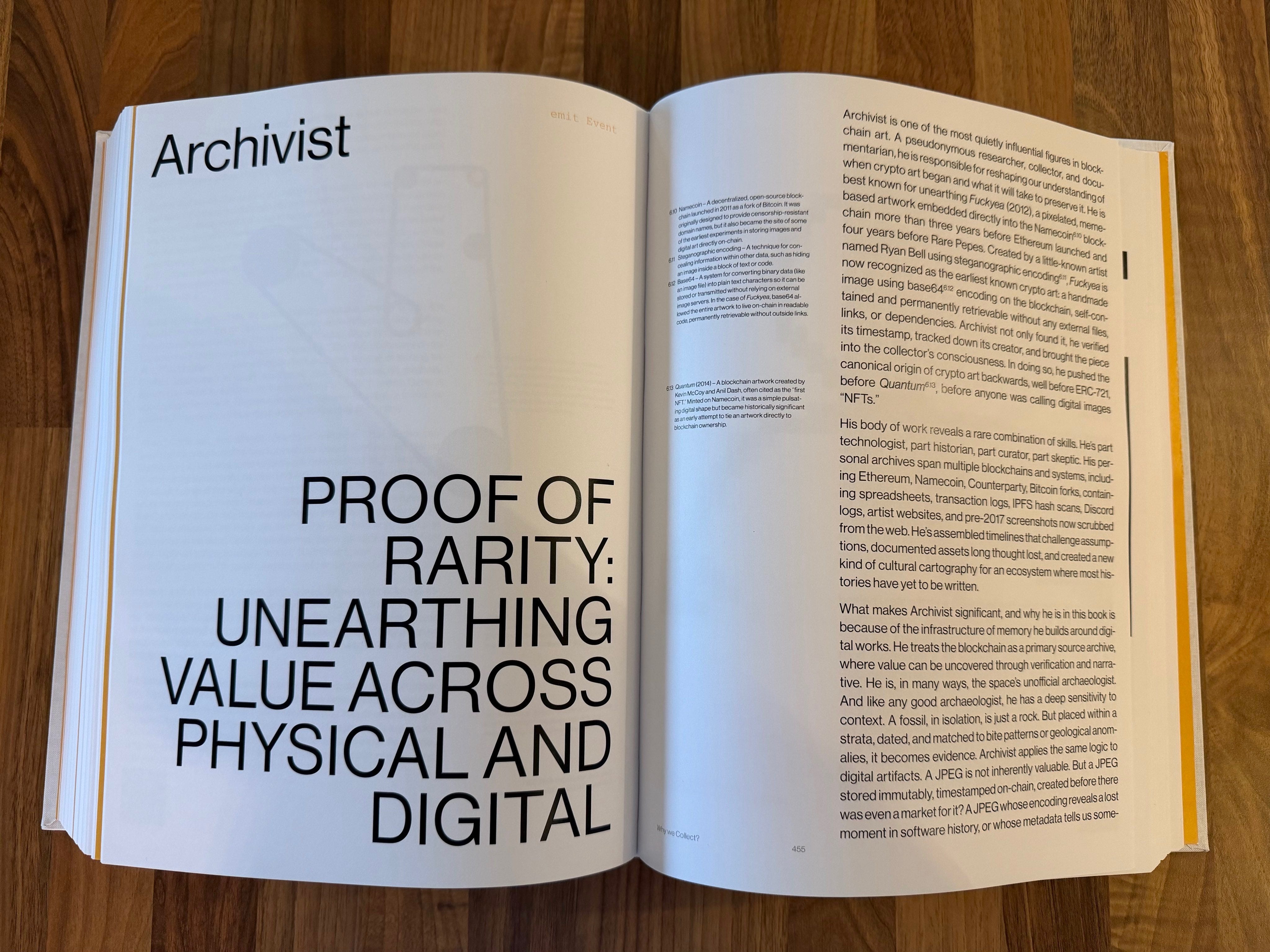
Years later, someone else noticed. Archivist.eth found it, decoded the inline image, and looked me up.
I bought a little Bitcoin back then, too. Eventually I sold it when I needed the cash, celebrating my keen 2x return on the initial investment, too broke to afford to hold onto it.
For years, crypto stayed in the background for me: fascinating, unfinished, and not quite mine.
The Tezos Rabbit Hole
Then I heard people talking about artwork on Tezos on a Proof podcast. That sent me down a rabbit hole. I found my way to the p5.js documentation, sketched out a simple box-drawing plot, and uploaded it.
Over the next few days, people started interacting with the project. They generated images, collected them, and made them their own. Seeing that happen was exciting in a way I had not expected. It felt joyful. It felt alive. I was hooked.
From there to 2025, I minted more than 5,000 unique digital artworks. What began as a strange little experiment became a decade-long blur.
The same Proof team would come back around and ask me to build the final Diamond Exhibit NFT for the longest-tenured holders of their Moonbirds collection. Another full circle.
And what a blur it was. There were stretches where I’d lose entire weeks to a single piece, debugging a generator at 3 AM because something about the output felt almost right but not quite. Other weeks I’d ship something in an afternoon and watch it land in collections halfway across the world before I’d finished my coffee. The pace had no rhythm. You’d be heads-down in an algorithm for days, then suddenly find yourself on a flight to an opening, then back home wondering if any of it had actually happened.
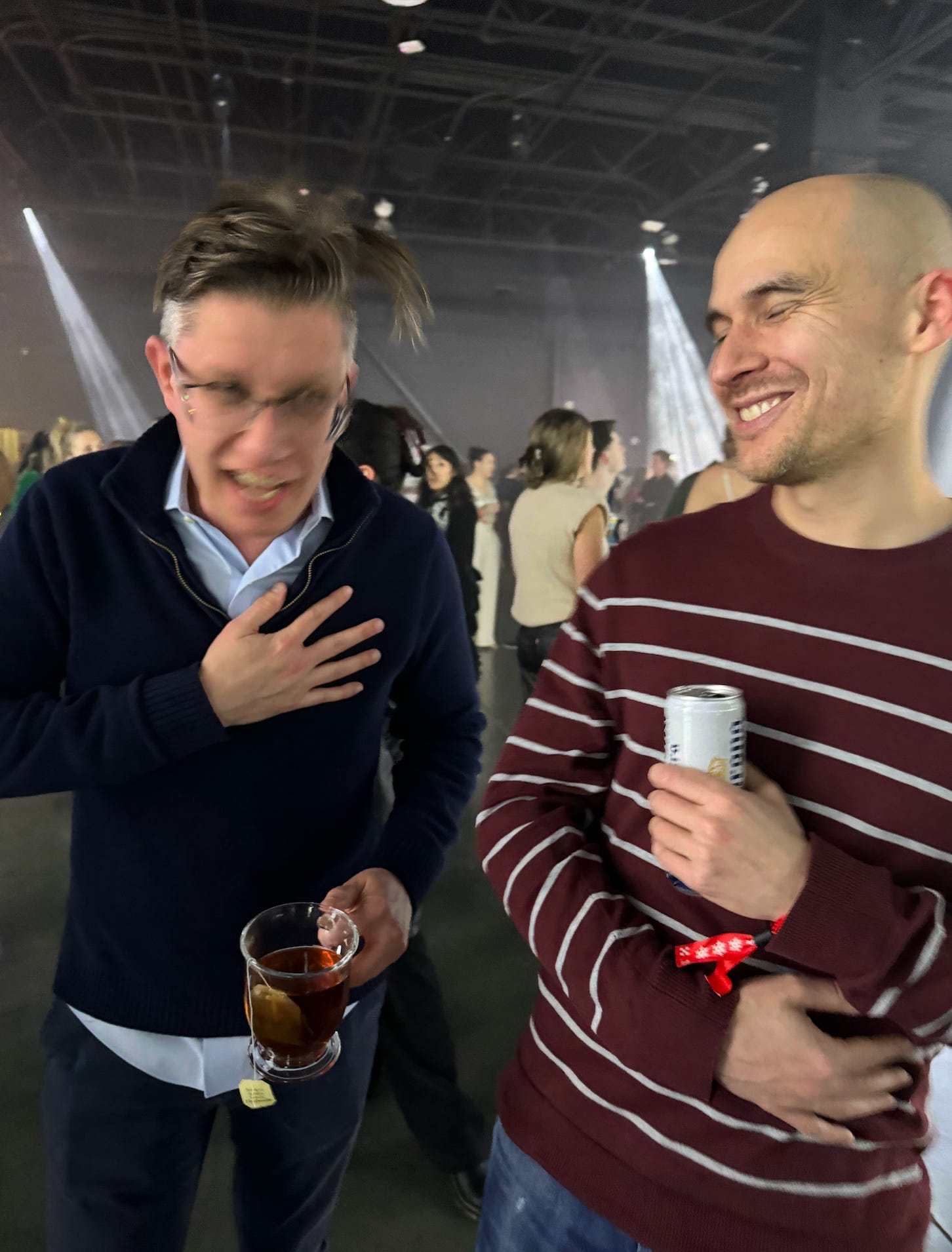
The work moved through Hong Kong, Switzerland, Paris, Berlin, and Los Angeles. Somewhere in the middle of it all, I found myself at an NFT party in New York with David Blaine, and later in Charleston with Beeple. Familiar names kept showing up in new chapters. A piece appearing alongside Herbert W. Franke’s, then a tribute show in his honor in Austria. My first mint later turned up in Taschen’s On NFTs, and more recently in Kate Vass Galerie’s Collecting Art Onchain.
It was surreal, absurd, and completely improbable.
The Polyglot Quine
My favorite experiment of them all became Bitcoin Inscription #104,096,021.

Gamma.io had invited me to mint original artwork on Bitcoin as part of an invite-only Ordinals program. I wanted to code-golf a JPEG.
I pulled it off. Rename the JPG as a ZIP and it opens into a tunnel: an archive that contains itself, expanding recursively. Inside is a PNG that runs as HTML-wrapped JavaScript. The final message is hidden in a second-order cellular automaton, playing backward as an interactive decoder ring.
I delivered the final media. They bailed. Their concern, as I understood it, was simple: they expected a JPG and I handed them steganographic crypto art that ran in the browser running code they didn't understand and didn't trust.
So the work never made it to market, and the partnership promptly ended.
After that, I started building the infrastructure to mint work directly from my own website. But the regulatory mood had shifted. Politicians were suddenly throwing around phrases like “unauthorized money transmitters,” “KYC,” and “safe harbor.” Strange initiatives started appearing, including funds to help artists who might get sued by the government. It scared me off, and I never launched it.
Later, I partnered with fxhash for a while. There was talk of a major Coinbase partnership and profit sharing around a new “artcoin” initiative they were cooking up. I was on vacation with my wife, but ended up spending the trip in a hotel room frantically grinding to make the work as strong as I possibly could. Then the whole thing collapsed: it was more of an “open for uploads” than any real Coinbase partnership, the art coins did not work, and the platform’s owner lost the motivation to keep the site functioning or deliver on roadmap initiatives as sales dwindled.
I left my job in crypto as they renamed the company and pivoted to AI, then I got another job... you guessed it, working in AI.
What a ride.
The Pattern
MP3s made music feel infinite. Blockchains made provenance feel programmable. NFTs made art feel liquid. AI is making creation feel effortless. Every wave starts as a strange new creative freedom, hardens into platforms and markets, then breaks open again when the next primitive shows up and hands the keys back to the tinkerers.
And if the pattern holds, the best part is always the early stretch: the weekend experiments, the tiny meme uploaded to a .bit domain that nobody notices, the sketch you ship before you’ve finished your coffee. That part still works. That part is always home.
Cheers! 🍻
-Ryan